Every ES chart is already drawing two invisible lines that most traders staring at candlesticks have never once turned on.
Not a moving average.
Not a trendline somebody hand-drew last week.
Not an oscillator sitting in its own pane below the candles.
Two lines, drawn straight off price itself: the highest point and the lowest point of roughly the last five hours of trading, updating in real time on 15-minute candles, quietly outlining a channel almost nobody actually watches close.
Those two lines were not invented for this. A pair of traders and a Chicago commodities legend built an entire system around this exact channel in the 1980s, using a lookback that traders still use today, unchanged.
This isn't about predicting where ES goes next.
It's about one moment: the exact 15-minute candle where price actually closes outside a range it hasn't left all session.
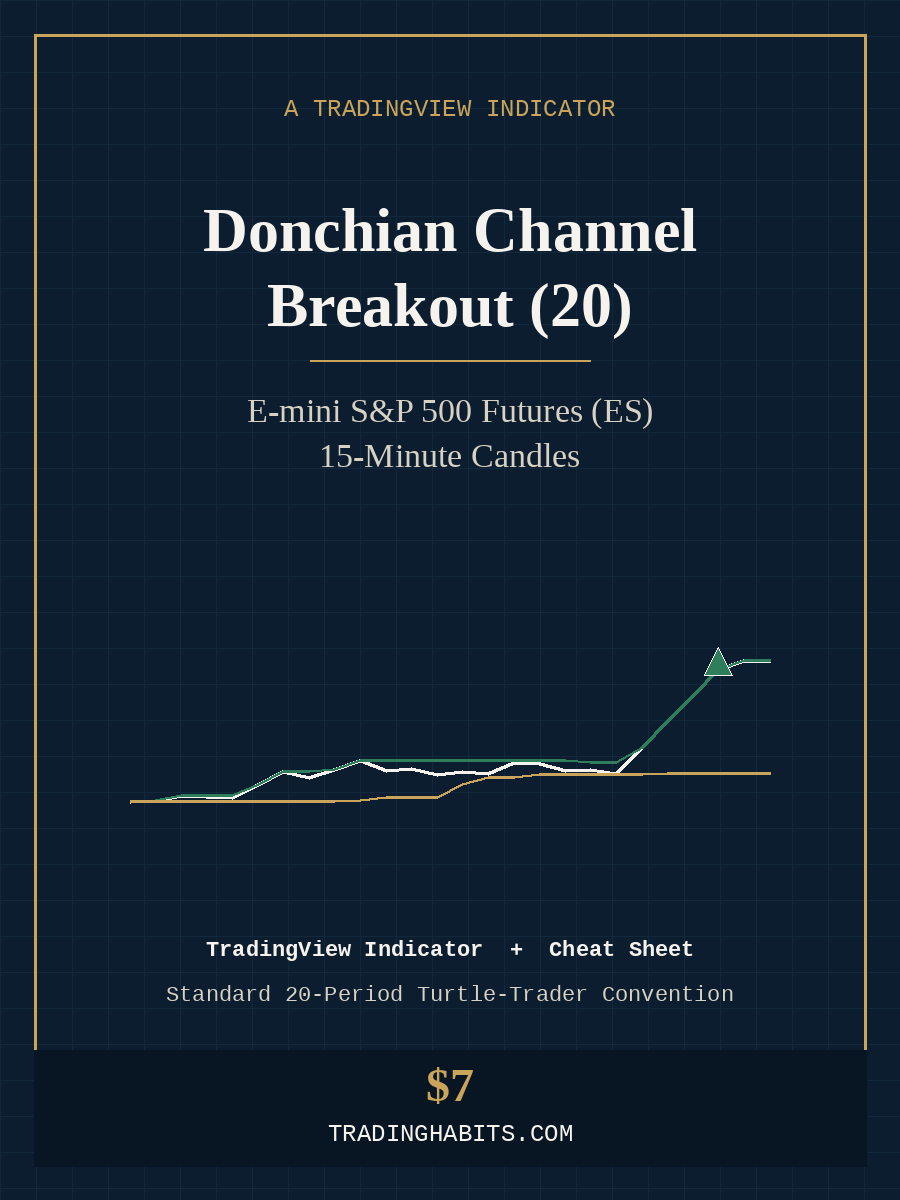
A small triangle, marked the second it happens, right on the chart, on the exact bar where the close breaks the channel.
Not a feeling. Not eyeballing where the range "probably" is. One channel, two lines, one confirmed close.
What those two lines actually are, the exact lookback behind them, and the 9 steps to get this live and alerting on your own ES chart, are all laid out below.
Nothing here promises what price does after that close. That part is still on you. But the moment itself, the one almost nobody has their chart set up to actually flag, is $7 and a couple minutes away.
A Trading Habits Indicator
Donchian Channel Breakout (20)
Richard Donchian's classic price channel, tuned to the Turtle Traders' 20-bar convention, coded for TradingView and built for E-mini S&P 500 futures on 15-minute candles.
- Includes A TradingView Indicator, plus a 7-page cheat sheet PDF
- Author TradingHabits.com
- Format Instant download, delivered right after checkout
- Covers What the Donchian Channel measures, the standard 20-bar convention and where it comes from, how to read the breakout signals, and exact numbered install steps for TradingView
This is a standard, documented indicator, coded clean and tested live on a real chart before it shipped.
What's Inside
20 Things This Cheat Sheet Actually Says
- 01The 1980s training experiment that turned a group of total novices into one of the most talked-about rules-based trading systems ever run, and the two-line tool sitting at the center of it. You're trusting a documented method instead of a random pair of lines someone drew, so you can look at your own chart with a steadier hand instead of guessing what they mean.Page 3
- 02What has to happen to price before this script will call something a breakout, and why "a touch" isn't enough, so a stray wick doesn't send you chasing a move that never actually confirmed.Page 3
- 03The two events, and only two events, this script is built to mark on the chart, so you're watching for two specific things instead of a screen full of noise competing for your attention.Page 2
- 04What the space between the two channel lines is quietly doing on every single bar, whether or not a breakout ever fires, so you can size up the current range at a glance instead of doing the math in your head.Page 5
- 05The exact lookback number this script uses, and the specific decades-old trading system that number is borrowed from, unchanged, so you're not left wondering whether 20 was picked for a reason or just picked.Page 3
- 06A second, longer lookback window the original system used for entries, and a third, shorter one it used for something else entirely, so you understand the fuller system this script's piece was pulled from, not just one number in isolation.Page 3
- 07What was different about the original version of this system and the version coded into this script, beyond just the lookback length, so you know exactly what was carried over unchanged and what was deliberately adapted for this chart.Page 3
- 08Three named sources this cheat sheet cites by name for where the 20-bar convention actually comes from, so you can go check the history yourself instead of taking this cheat sheet's word for it.Page 3
- 09The one property of a heavily traded futures contract that this cheat sheet says makes a breakout reading more trustworthy, so you understand why the instrument underneath a signal matters as much as the signal itself.Page 4
- 10Roughly how many hours of price action a single 20-bar window covers on this build's timeframe, and why that specific window was chosen over a full trading day, so you understand the tradeoff behind the choice instead of just accepting a number on a settings panel.Page 4
- 11What this cheat sheet says outright about whether this build was ever tested as a generic "any market, any timeframe" tool, so you know exactly where this build's testing stops and your own homework has to start.Page 4
- 12The exact colors and shapes marking an upper breakout versus a lower breakout, and what has to happen on the bar's close before either one appears, so you can glance at a live chart and know instantly which side just broke, without hunting through a legend.Page 5
- 13What the diagram on this page is explicitly labeled as, and the one thing this cheat sheet says it is not, so you know exactly what you're looking at instead of mistaking an example for a promise.Page 5
- 14Nine numbered steps stand between opening TradingView and having this indicator live and alerting on an ES futures chart, so the whole setup fits into a coffee break instead of an afternoon lost to a manual.Page 6
- 15The two settings inside this script's gear icon that let a person change the channel length or turn off the shading and markers, without touching a single line of code, so the script keeps working for you even if your own trading style shifts down the road.Page 6
- 16What actually happened when this script was pasted into a live Pine Editor on a real ES chart, down to the specific values that printed in the chart's own legend, so you're seeing the actual proof it compiled clean instead of taking "it works" on faith.Page 6
- 17What this cheat sheet says happens on the chart during a choppy, range-bound session, and why that's called expected behavior instead of a flaw, so a rough stretch on the chart doesn't have you second-guessing a tool that's working exactly as designed.Page 7
- 18The specific delay built into every single signal this script produces, and why it can never fire before the move has already started, so you go in with eyes open about what confirmation costs instead of expecting a crystal ball.Page 7
- 19What this cheat sheet says a breakout signal has zero connection to, no matter how confident that signal looks on the chart, so your own risk decisions stay in your own hands instead of getting handed off to a chart marker.Page 7
- 20What this cheat sheet says was never run to produce this product, and the exact claim it explicitly refuses to make anywhere inside it, so what you're buying is an honest tool, not a sales pitch dressed up as one.Page 7
HABITS
★
Certificate of Guarantee
60-Day, No-Questions-Asked
If Donchian Channel Breakout (20) doesn't earn its place in your indicator list, email us any time within 60 days of purchase for a full refund. No form to fill out. No reason required.
Instant Download
$7One-time payment. No subscription.
Order NowTRADINGVIEW INDICATOR + 7-PAGE CHEAT SHEET · DELIVERED IMMEDIATELY AFTER CHECKOUT · 60-DAY GUARANTEE