Most trading calendars are decoration. This one recalculates.
You already know the drill. One tab for market holidays. Another for the Fed's meeting schedule. A third tab, usually a half-remembered rule, for when jobs data or CPI tends to land.
None of it sits in one place. None of it updates itself.
This is one workbook. Market holidays and early-close days for 2026. The Federal Reserve's own tentative FOMC meeting schedule. A plain reference for when the recurring economic releases typically show up each month.
The FOMC tab counts down on its own. Open the file in March or in November and the days-until-decision column has already recalculated. No formula editing required.
The Fed can still call an unscheduled meeting whenever it wants. That part, no workbook fixes.
Nothing here predicts a Fed decision, a jobs number, or which way a market moves around any of these dates. It's a calendar, not a forecast.
Every date got checked against the source that actually sets it. NYSE.com for holidays. Federalreserve.gov for FOMC. Before any of this went out the door.
Bring it up before you plan around a date. Not after you've already guessed which Monday in September the market's actually open.
A Trading Habits Tool
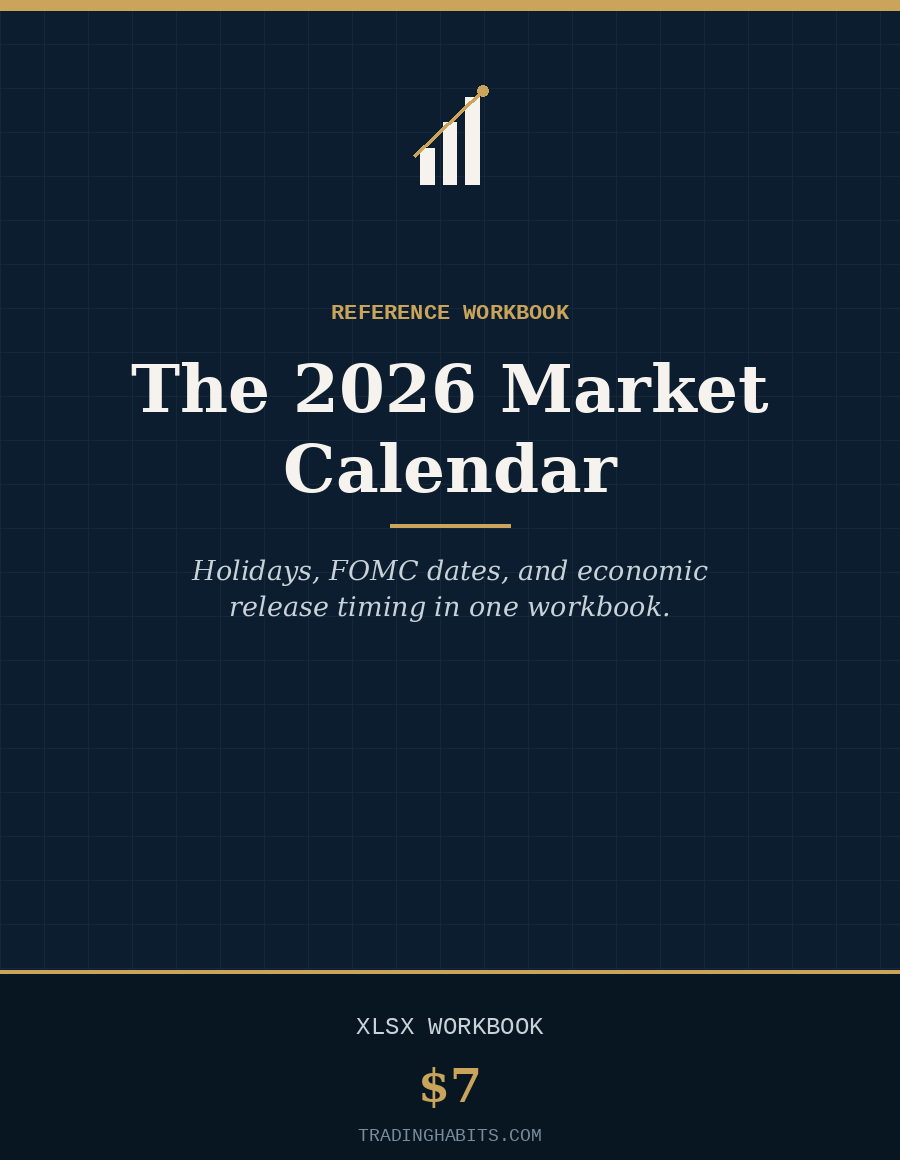
The 2026 Market Calendar & Economic Events Reference
One workbook for market holidays, FOMC dates, and typical economic release timing.
- Format Excel workbook (.xlsx), opens in Excel, Google Sheets, or Numbers
- Tabs 2026 Market Holidays, 2026 FOMC Meeting Dates, Recurring Economic Releases, Instructions
- Data 12 holiday/early-close dates, 8 FOMC meetings, 7 recurring release patterns
- Delivery Instant download right after checkout
Sourced from NYSE.com and federalreserve.gov, not guessed at.
What's Inside
What's Inside The 2026 Market Calendar
- 01All 10 full U.S. stock market closures for 2026 plus the 2 early-close days, each with the exact date and day of week calculated automatically.
- 02The Federal Reserve's own tentative 2026 FOMC meeting schedule, all 8 meetings, start date and decision day both listed.
- 03A "Days Until Decision Day" column that recalculates itself from today's date every time you open the file.
- 04A flag for which 4 FOMC meetings include the Summary of Economic Projections, so you know which ones carry the dot plot.
- 05A plain reference for when Non-Farm Payrolls, CPI, PPI, Retail Sales, GDP, the Beige Book, and jobless claims typically land each month.
- 06Every date checked against its actual source, NYSE.com for the exchange calendar, federalreserve.gov for the Fed, before this shipped.
- 07A full instructions tab explaining exactly what this workbook does and doesn't do.
- 08No macros, no plug-ins, no login. Opens in Excel, Google Sheets, or Numbers.
HABITS
★
Certificate of Guarantee
60-Day, No-Questions-Asked
If The 2026 Market Calendar doesn't earn a spot in your files, email us any time within 60 days of purchase for a full refund. No form to fill out. No reason required.
Instant Download
$7One-time payment. No subscription.
Order NowXLSX WORKBOOK · DELIVERED IMMEDIATELY AFTER CHECKOUT · 60-DAY GUARANTEE
Behind The Tool
Scheduled Disclosure And Market Calendars
The Concept
A calendar like this one isn't a forecast. It's a list of moments the market has already agreed, in advance, to react to. Trading full size into one of those moments is a choice, not an accident, once the date is already sitting in front of you.
Position sizing gets easier to plan around a scheduled release than an unscheduled one. The risk doesn't disappear. It just stops being a surprise.
Where It Comes From
The Federal Reserve was created by the Federal Reserve Act of 1913. The Federal Open Market Committee, the body that actually sets the target interest rate, got its current legal structure later, from the Banking Act of 1935. For decades after that, the Fed said almost nothing right after a meeting, and traders often had to infer a policy shift from its own trading desk activity. That changed in 1994, when the Fed started issuing a statement immediately after every meeting instead of letting the market guess.
Scheduled economic data has its own history. The agency now known as the Bureau of Labor Statistics traces back to a Bureau of Labor created inside the Department of the Interior in 1884, before labor statistics had a cabinet department of its own. Its monthly employment report is still released on a date announced months in advance, specifically so no single trader gets the number early.
The FOMC's Own Cadence Across A Year
Illustrative spacing based on the Fed's published tentative schedule. Roughly six to seven weeks between meetings, with the longest gap of the year sitting between December and the following January, which is exactly the kind of gap this workbook's countdown column is built to track.
Try It: Step Through The FOMC's Own Cadence
Illustrative spacing matching the chart above, based on the Fed's typical six-to-seven-week cadence, not exact 2026 dates. Step through the year and watch the gap stretch right before January, the exact stretch this workbook's countdown column exists to track.
Background only. The workbook itself carries the actual 2026 dates, verified against the Fed's own published schedule and the exchanges' own holiday calendars.
Common Questions
Why did the Fed start issuing statements right after every meeting?
Before 1994, the market often had to infer a policy shift from the Fed's own trading desk activity instead of an announcement. The 1994 change replaced that guesswork with an immediate statement, part of why FOMC days now move markets on a schedule instead of a surprise.
Are all eight FOMC meetings spaced evenly?
Roughly six to seven weeks apart, with one exception. The longest gap of the year sits between the December meeting and the following January, exactly the stretch this workbook's countdown column is built to flag.
Does the monthly jobs report get released on a random date?
No. It comes from the Bureau of Labor Statistics, an agency tracing back to 1884, and the release date is announced months ahead specifically so no single trader gets the number early.
What's the actual point of knowing these dates in advance?
Position sizing gets easier to plan around a scheduled release than an unscheduled one. The risk from the event doesn't disappear. It stops being a surprise you're sizing blind against.