Every futures trader learns the same lesson eventually. The only question is whether it costs a few ticks or an entire account.
Stocks have a start time and an end time. Futures don't. ES and NQ trade something close to 23 hours a day, five days a week, which means the chart never fully stops and neither does the risk sitting on an open position while the rest of the country sleeps.
A ten-lot of micro contracts feels smaller than one E-mini, right up until the math says otherwise. The margin number that looked fine at the open can turn into a broker-issued liquidation notice by the time the overnight margin requirement kicks in. None of that is complicated once it's actually explained. Most of it never gets explained before the account learns it the expensive way.
ES, MES, NQ, and MNQ. Crude oil and gold. The course covers margin, leverage, and what changes the moment the cash session closes, plus tick value, contract specs, and position sizing that runs on a formula instead of a feeling.
Ten modules. The actual mechanics behind the instruments this entire site keeps pointing back to, built for someone ready to trade them on purpose.
A Trading Habits Course
The Futures Trading System
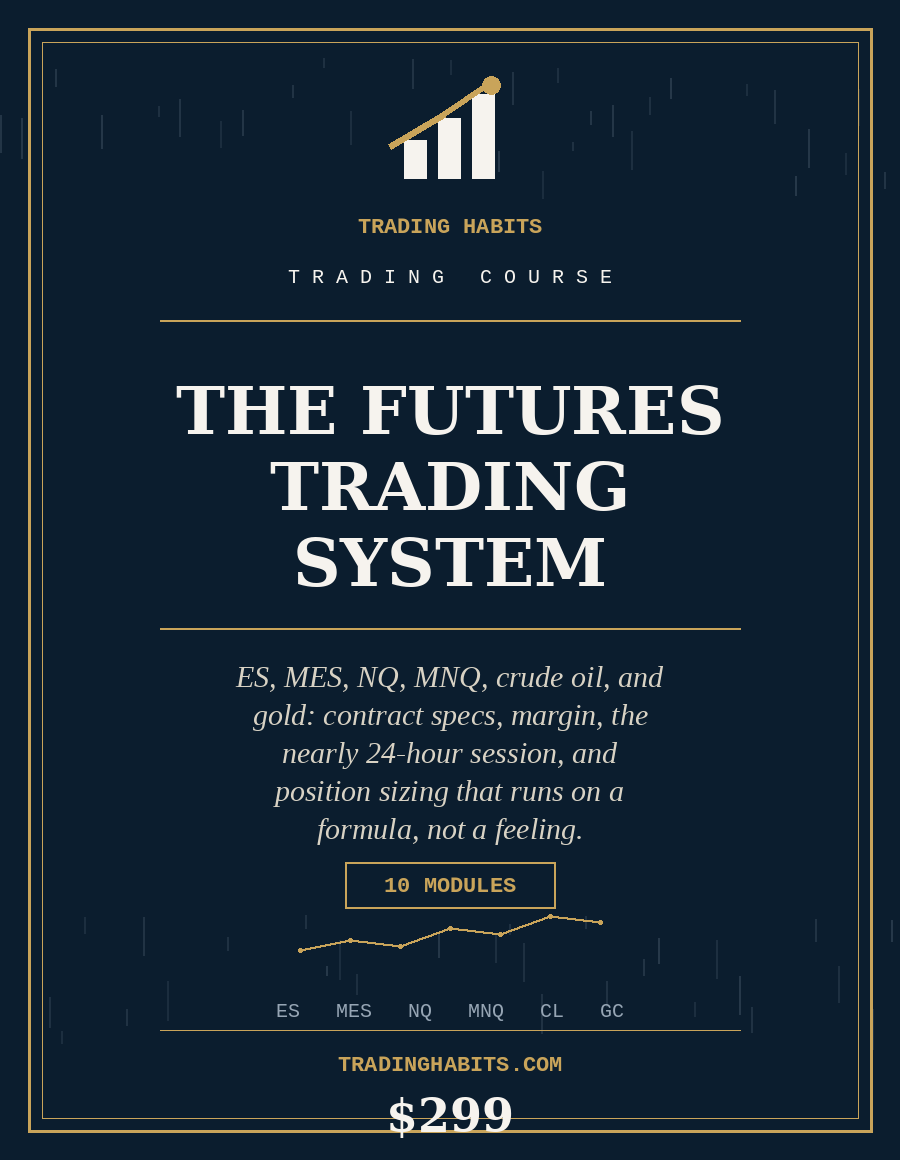
ES, MES, NQ, MNQ, crude oil, and gold: contract specs, margin, the nearly 24-hour session, and position sizing that runs on a formula, not a feeling.
- Length 10 modules, built for genuine depth, not padding
- Format A private, self-paced course page with working tick-value, leverage, and position-size calculators built into the lessons, not links out to them
- Access Instant, right after checkout, yours to re-read for good
- Covers Contract mechanics, ES/MES/NQ/MNQ specs, crude oil and gold, margin and leverage, the Globex session, PDT and tax treatment differences, position sizing in ticks, four setups to backtest, and an 8-week paper-to-live ramp
- Author TradingHabits.com
Built for one job: turning ES, MES, NQ, MNQ, CL, and GC from four-letter tickers into instruments a trader understands the mechanics of before risking a single tick.



What's Inside
The 10 Modules
- 01What a futures contract is: standardization, mark-to-market, expiration, and rollover.Module 1
- 02E-mini and micro contracts: ES, MES, NQ, MNQ, with the tick-value formula worked in full.Module 2
- 03Crude oil and gold: CL and GC contract specs, and what moves each one.Module 3
- 04Margin, leverage, and the sharp jump between day-trading margin and overnight margin.Module 4
- 05The nearly 24-hour session: Globex liquidity by hour, and the overnight gap risk that comes with it.Module 5
- 06Trading ES and NQ intraday: the opening range, VWAP, and reading an overnight chart.Module 6
- 07Futures vs. options vs. stocks: no PDT rule, and the Section 1256 60/40 tax treatment.Module 7
- 08Position sizing in ticks and contracts, with the formula that catches the micro-contract sizing trap.Module 8
- 09Four futures setups to study and backtest yourself, built from tools covered earlier in the course.Module 9
- 10Five behavioral failure patterns specific to futures, and an 8-week path from simulator to live size.Module 10
Read This Before You Buy
Who This Course Actually Fits
You're a fit if
- You already trade or want to trade ES, NQ, or their micro contracts and want the actual mechanics behind margin, tick value, and the overnight session.
- You've heard futures don't carry the PDT rule and want to understand exactly why, and what does still apply instead.
- You want position sizing built from a formula, not a guess based on how "small" a micro contract feels.
- You're willing to study crude oil and gold as their own instruments instead of assuming they behave like an index.
- You're comfortable with a small, structured paper-to-live ramp instead of trading full size on day one.
Skip it for now if
- You're looking for alerts, a chat room, or a signal feed. This is a system to understand, not a feed to follow.
- You've never placed any kind of trade before. This course assumes basic familiarity with charts and orders.
- You want a guarantee that leverage makes a small account grow faster with less risk. No course can honestly offer that, and Module 4 explains exactly why leverage cuts both ways.
- You're already sizing futures positions with a tick-value formula and a risk budget you trust. You may already have what this course teaches.
HABITS
★
Certificate of Guarantee
60-Day, No-Questions-Asked
If The Futures Trading System doesn't earn its place in your process, email us any time within 60 days of purchase for a full refund. No form to fill out. No reason required.
Instant Access
$299One-time payment. No subscription.
Get Instant Access10-MODULE DIGITAL COURSE · DELIVERED IMMEDIATELY AFTER CHECKOUT · 60-DAY GUARANTEE
Behind The Course
How Retail Traders Got a Seat at the Futures Table
September 9, 1997
CME launched the E-mini S&P 500, the first E-mini contract on record, sized at one-fifth of the standard S&P contract and requiring one-fifth the margin. It traded over 7,000 contracts on day one and, trading exclusively through CME's Globex electronic platform, opened index futures to traders who could never have posted the standard contract's full margin.
May 6, 2019
CME Group launched Micro E-mini futures on the S&P 500, Nasdaq-100, Russell 2000, and Dow, each sized at one-tenth of its existing E-mini sibling. It became, within days, the most successful new product launch in CME's history at that point, the moment MES and MNQ became the entry point most new futures traders start at.
From a Full-Size Contract to a Micro One, in Two Steps
Two dated product launches, 22 years apart, that each cut the margin required to trade an index by roughly five to ten times.
Try It: The Tick-Value Math From Module 2
Same formula Module 2 works with ES, MES, NQ, MNQ, CL, and GC by name: tick size times contract multiplier equals tick value. Every position-sizing calculation in the course starts here.
Background only. The course itself works the margin, leverage, session-timing, and position-sizing mechanics a futures account runs on.
Common Questions
When did retail-sized futures contracts actually show up?
Twice, 22 years apart. CME launched the E-mini S&P 500 on September 9, 1997, at one-fifth the standard contract's size and margin, trading over 7,000 contracts on day one. CME Group launched Micro E-mini futures on May 6, 2019, at one-tenth the size of the existing E-mini.
How big a deal was the Micro E-mini launch?
It became, within days, the most successful new product launch in CME's history at that point, and it's the entry point most new futures traders start at today.
What's the actual formula behind a tick value?
Tick size times contract multiplier. Module 2 works through it by name for ES, MES, NQ, MNQ, CL, and GC, and every position-sizing calculation in the course starts from that one number.