There's a single decision that costs more trading accounts than a bad entry, a bad exit, or a bad indicator combined.
It's not overtrading.
It's not leverage, although leverage makes it worse.
It's not even revenge trading, not the version most people picture.
It happens in the 30 seconds after a loss closes, before the next trade gets sized.
Researchers who study it gave it a name: the break-even effect.
Most traders have never heard the term.
Fewer still know a 1990 study found people will take on more risk for almost nothing else the way they will for a bet that promises to get them back to exactly even.
It isn't about the market. It's about which number your brain is trying to erase.
One walked-through example turns a $100 planned loss into $200, without a single new fact about the trade itself.
Another turns a six-trade losing streak that should have cost $1,800 into one that costs nearly $9,600.
Neither one required a worse strategy.
Both required one sizing decision, made under pressure, that a calmer version of the same trader would never have made.
That decision has a name, a body of research behind it, and a documented cost that compounds every time it survives a losing streak.
All three are laid out below, with the exact page where each one is discussed.
A Trading Habits Report
The Get-Even Trade
What sizing up to win back a loss actually costs, in the math and in the research.
- Length 20 pages, with 9 original charts and data tables
- Author TradingHabits.com
- Format PDF, delivered as an instant download right after checkout
- Covers The psychology behind sizing up the next trade after a loss, what it costs in worked-through numbers, and what the research says actually stops it
This report breaks down the research, the math, and a plan you can use on your next trade.
What's Inside
20 Things This Report Actually Says
- 01The exact multiplier a position hits after four straight losses, laid out at three different size-increase habits, including the one that turns a normal losing streak into an account-ending one.Page 13
- 02Why closing a losing trade at the planned stop, instead of holding it, should make the next decision calmer, according to one 2016 study on realized versus paper losses. And why it often doesn't work that way anyway.Page 7
- 03The number Kahneman and Tversky put on why a loss hurts roughly twice as hard as an equal gain feels good.Page 5
- 04What a 1990 study found people will risk more on than almost any other kind of bet, specifically because it offers a shot at getting back to exactly even.Page 6
- 05Cortisol was supposed to make traders more reckless after a loss. One study published in a major science journal found something closer to the opposite.Page 9
- 06The share of gamblers in one body of research who admitted to chasing a loss with a bigger bet, and how much higher that number climbs among problem gamblers specifically.Page 8
- 07What a 2009 study of sequential betting found about the gap between the bet size people planned in advance and the one they actually placed the moment after losing.Page 10
- 08A $10,000 account, two ordinary losing trades, and one sizing decision on trade three that turns a $100 loss into something worth twice that. Walked through step by step.Page 11
- 09What the same six losing trades do to a $20,000 account under two different sizing habits. One path ends at $18,200. The other ends near half the account gone.Page 12
- 10What one widely cited academic study, built on exchange-sourced data, found about how many Brazilian day traders were actually net profitable.Page 14
- 11The reported share of prop firm evaluation failures traced to one specific rule breach, and the exact trading pattern firms say causes most of them.Page 15
- 12Five specific tells that the next trade is about to get sized by emotion instead of the plan. Two of them show up before the trade is even placed.Page 16
- 13Four mechanical changes, one borrowed directly from how prop firms already police this exact behavior, that remove the decision before pressure ever gets a vote.Page 17
- 14A four-line written rule built to be checked in the moment a loss happens, not remembered after it already didn't work.Page 18
- 15The specific line between this behavior and ordinary overtrading, and why mixing the two up makes it harder to actually fix either one.Page 4
- 16The reason regulators in three separate countries now force brokers to publish exactly how many retail accounts make money.Page 14
- 17Why the losing streak long enough to end an account only has to happen once, and how ordinary a four or five trade losing streak actually is.Page 13
- 18Four questions worth asking the moment you notice a trade got sized bigger than the plan called for, and what each one is actually checking for underneath.Page 19
- 19What an oversized “get-even” trade is actually trying to erase. It was never the number on the screen.Page 6
- 20What Lo and Repin found when they wired up professional traders during live trading sessions, and why experience didn't make the physical reaction disappear.Page 9
HABITS
★
Certificate of Guarantee
60-Day, No-Questions-Asked
If The Get-Even Trade doesn't earn its place on your desk, email us any time within 60 days of purchase for a full refund. No form to fill out. No reason required.
Instant Download
$7One-time payment. No subscription.
Order Now20-PAGE PDF · DELIVERED IMMEDIATELY AFTER CHECKOUT · 60-DAY GUARANTEE
Behind The Report
The Break-Even Effect
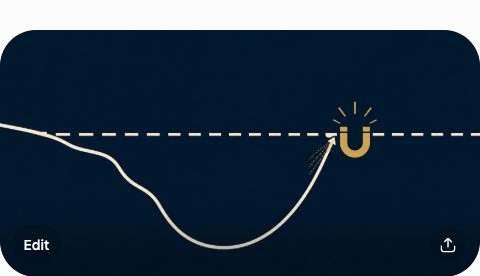
Break-even acts like a magnet. The pull to touch it again, not the setup itself, is what drives the trade.
The Concept
The break-even effect describes a specific shift in what risk looks acceptable right after a loss. People become willing to take a bet they'd normally turn down, as long as it has a shot at erasing the loss. The odds on the new bet rarely get a second look. The only thing that matters is that the number goes back to where it was.
Sizing up the next trade to "win it back fast" is that effect, running live in a trading account.
Where It Comes From
Richard Thaler, who went on to win the 2017 Nobel Prize in Economics, and Eric Johnson published the defining paper on this in Management Science in 1990, titled "Gambling with the House Money and Trying to Break Even." It's one of the most cited papers in behavioral finance.
The paper actually found two separate effects. One is the house money effect: more risk-taking after a win. The other is the break-even effect: more risk-taking after a loss, aimed specifically at getting back to zero. This report is about the second one.
What "Getting Even Fast" Requires
Illustrative comparison. A trader risking a flat 1% keeps every loss the same size. A trader trying to erase each loss in one shot by doubling size, 1% to 2% to 4% to 8%, only needs four straight losing trades before a single position is risking 8% of the account.
Try It: Watch Risk Compound When You Chase Even
Same doubling pattern as the chart, run on your own starting risk. Each straight loss chased at double size instead of staying flat turns a modest number into an outsized one fast, well before most traders expect it to.
Background only. The report itself works the math on what sizing up after a loss actually does to an account over time.
Common Questions
What's the difference between the "house money effect" and the "break-even effect"?
Both come from the same 1990 Management Science paper by Richard Thaler, who later won the 2017 Nobel Prize in Economics, and Eric Johnson. The house money effect is taking more risk after a win. The break-even effect, the one this report is about, is taking more risk after a loss specifically to get back to zero.
How fast does risk actually compound when you try to "win it back fast"?
Faster than it feels. Doubling size after each loss, 1% to 2% to 4% to 8%, only takes four straight losing trades before a single position is risking 8% of the account.
Does the "get even" trade's own odds get a second look under this pattern?
No, and that's the core finding. The bet's own odds rarely get evaluated. The only thing that matters, in the moment, is that the number goes back to where it was.