There's a moment inside almost every losing session that decides how bad the day actually gets, and it isn't the moment the first trade goes red.
It isn't the setup being wrong, because the setups earlier in the day were often fine.
The market didn't turn hostile either, because the same conditions get traded clean by someone two seats over.
It isn't even the size of the trade that finally breaks the daily limit, because that one usually matched the plan too.
It's the trade that comes right after the limit is already gone, the one that somehow doesn't feel like a new decision at all.
One prop firm that tracks its own funded-account failures put an exact number on how often this single behavior is the reason an account gets shut down: 78.7%.
Not a bad strategy. Not one catastrophic trade. It was crossing a line that had already been drawn, in writing, before the session opened.
Psychologists gave the moment a name, and it has nothing to do with trading.
It comes from research on why people who've spent a long stretch making decisions become the worst possible version of themselves for the one decision that actually matters.
Traders who've never heard the term are living inside it every session, at the exact minute they need their own rule the most.
A simulation built for this report ran 20,000 modeled trading days through two versions of the same trader, one that stopped at the line and one that didn't, with nothing else changed.
The two averages came out almost identical.
The difference wasn't in the average at all. It was in how often an ordinary bad day turned into a genuinely bad one, and that number climbed every single time one more trade got added.
All of it, the 78.7%, the psychology behind it, the 20,000-day simulation, and the exact dollar math on what one more trade costs, is laid out below, with the page number where each piece lives.
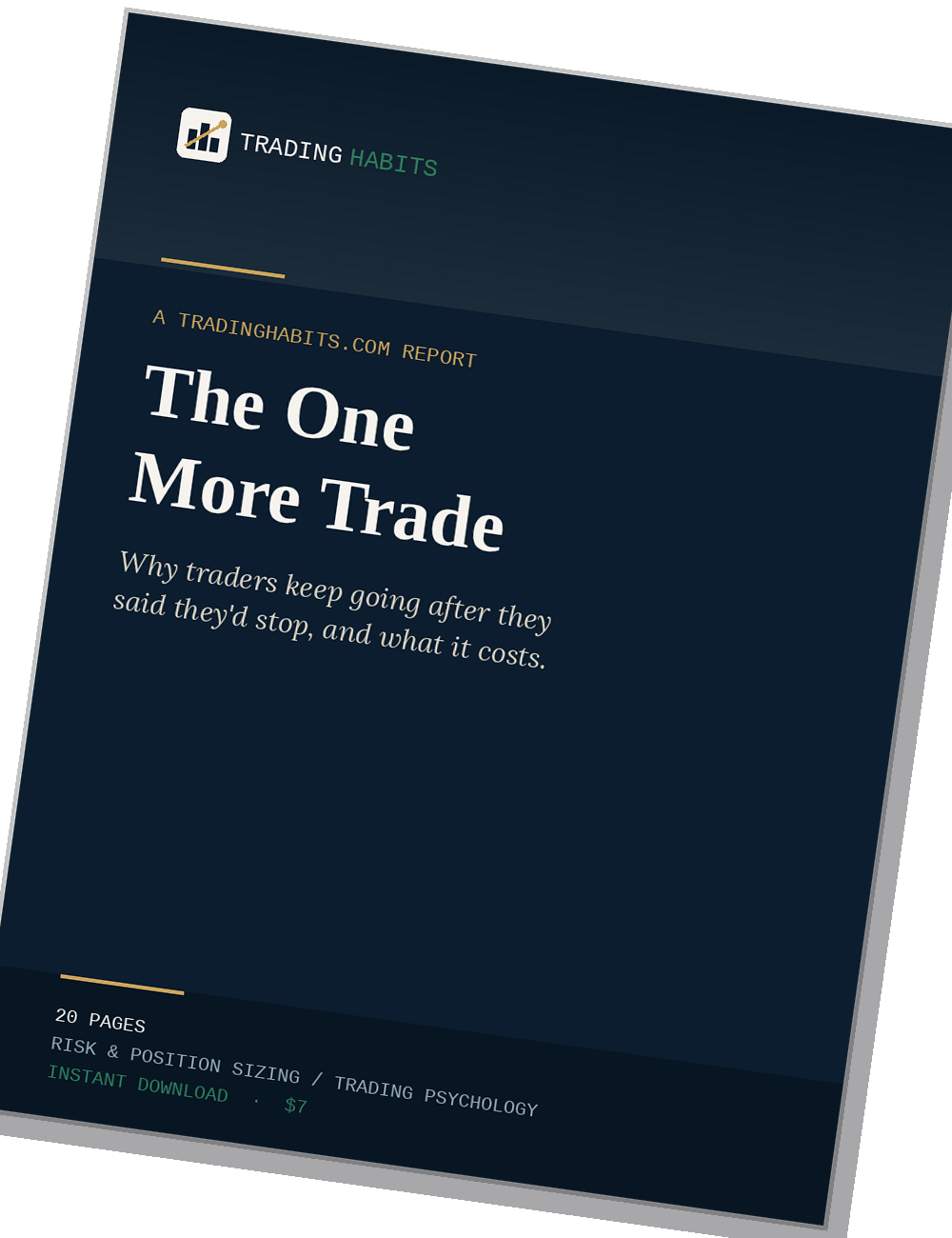
A Trading Habits Report
The One More Trade
Why traders keep going after they said they'd stop for the day, and what it actually costs, worked out in full.
- Length 20 pages, with 8 original charts and two worked hypothetical case studies
- Author TradingHabits.com
- Format PDF, delivered as an instant download right after checkout
- Covers The psychology and data behind trading past a daily loss limit, a 20,000-day Monte Carlo simulation of what it costs, and the recovery math on paying it back
This report breaks down the research, the math, and the numbers on one specific decision.
What's Inside
20 Things This Report Actually Says
- 01The one specific moment, and it happens in under a second, when an ordinary losing day turns into something much worse.Page 3
- 02How to tell the difference between a bad trading habit that gets its own report and the one specific decision this report is actually about.Page 3
- 03Why closing the platform on a red day doesn't feel like locking in a loss, even though the loss is already real the second it happens.Page 4
- 04The 1979 economics paper that measured, in exact numbers, how much harder a loss hits than an equal-sized win, and the multiple isn't a round one.Page 5
- 05What one prop firm's own published numbers say is the single biggest reason funded-account challenges get failed, and it isn't a bad strategy.Page 6
- 06The percentage of evaluation traders who actually make it to a funded account, according to industry estimates.Page 6
- 07Two different sources, two different methodologies, one number that barely moves between them.Page 7
- 08The pinball machine that gave poker players, and now traders, the exact word for the moment self-control checks out.Page 8
- 09What a 2020 study of online poker players found actually predicted losing control, and it wasn't anxiety or depression.Page 8
- 10The exact dollar gap between a trader who keeps their size flat after blowing a limit and one whose size creeps up 25% a trade.Page 9
- 11What six extra trades cost on a $5,000 account once the daily limit was already gone, worked out in plain arithmetic.Page 10
- 12The 1998 psychology finding that explains why willpower tends to fail at the exact moment a trader needs it most.Page 11
- 13What separated the higher-performing traders from the lower-performing ones in a study of professional trading floors, and it had nothing to do with strategy.Page 11
- 14One ordinary Tuesday, a $150 limit, and four extra trades: the walkthrough of exactly how a losing day turns into a much worse one.Page 13
- 15The exact multiple a hypothetical $5,000 account went over its own daily limit after four "just one more" trades.Page 13
- 1620,000 simulated trading days, one rule changed between them, and what happened to the results.Page 15
- 17Why the average outcome across thousands of simulated trading days looked almost identical for two different strategies, and where the real difference was actually hiding.Page 17
- 18How many extra trades it took, in a 30,000-trial simulation, before the odds of a genuine blowout day started climbing fast.Page 17
- 19The simple formula for how many good trading days it takes to earn back one bad one, and what it looks like at five different gain assumptions.Page 19
- 20A second hypothetical account, a $200 limit, and a final number nearly three times the size of the original plan.Page 20
HABITS
★
Certificate of Guarantee
60-Day, No-Questions-Asked
If The One More Trade doesn't earn its place on your desk, email us any time within 60 days of purchase for a full refund. No form to fill out. No reason required.
Instant Download
$7One-time payment. No subscription.
Order Now20-PAGE PDF · DELIVERED IMMEDIATELY AFTER CHECKOUT · 60-DAY GUARANTEE
Behind The Report
Ego Depletion And Trading Tilt
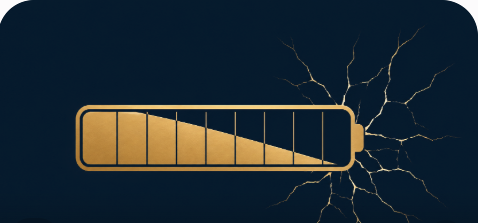
Discipline isn't a fixed trait. It's a battery, and every decision of the session drains it a little more.
The Concept
A daily loss limit only gets tested at the exact moment discipline is weakest, which is precisely why it gets broken. Setting the rule at 8 a.m. is easy. Holding it at 1 p.m., three losing trades deep, is a different kind of hard entirely.
Poker players call the state that follows a big loss "tilt": a specific, recognizable drop in decision quality right after a setback, not a vague mood.
Where It Comes From
Psychologist Roy Baumeister and colleagues proposed in a 1998 Journal of Personality and Social Psychology paper that self-control draws from a limited resource that depletes with use, a theory they called ego depletion. It became one of the most influential ideas in psychology for over a decade.
There's a catch worth knowing. A large 2016 multi-lab replication effort failed to reproduce the original ego-depletion effect, and the theory is now genuinely contested inside psychology. What hasn't been contested is the pattern itself: a 2020 study documented tilt directly in online poker play, and one more trade after the limit's already been hit is the trading floor's version of it.
Size Creep After The Limit's Already Hit
Illustrative pattern: a $150 daily limit already hit, then four more trades with size creeping up roughly 25% each time instead of staying flat or shrinking. The limit was meant to stop the day at $150. Size creep alone nearly doubles the number it was built to cap.
Try It: Size Creep After Your Own Limit's Already Hit
Same 25% creep as the chart, run on your own daily limit. The limit was built to cap the day. Size creep alone can nearly double the number it was supposed to stop, four trades past the point it should have ended.
Background only. The report itself runs the prop-firm failure data and a 20,000-day simulation of what trading past the limit costs.
Common Questions
Is "ego depletion" a settled scientific idea?
No, and it's worth knowing that going in. Roy Baumeister's 1998 paper proposed that self-control draws from a limited, depletable resource, and it became one of psychology's most influential ideas for over a decade. A large 2016 multi-lab replication effort failed to reproduce the original effect, and the theory is now genuinely contested.
If the theory is contested, why does this report still use it?
Because the pattern it describes held up separately. A 2020 study documented "tilt," a measurable drop in decision quality after a big loss, directly in online poker play. One more trade after a daily limit's already been hit is the trading floor's version of the same pattern.
How fast does size actually creep after a limit's already been hit?
Fast. A $150 daily limit already hit, then four more trades with size creeping up about 25% each time, climbs from $150 to $188 to $234 to $293, nearly doubling the number the limit was built to cap.