There's a moment inside a winning trade that never makes it into the post-mortem, because by the time the trade is closed, it doesn't feel like the moment that mattered.
It isn't the entry.
It isn't the stop.
It's the exact instant the trade hits the number you already said you'd take.
And you don't take it.
A model built in 1979, for economics, not trading, predicts something backwards about exactly that instant. A 1990 study about gambling with money you already won explains the rest of it.
There's an exact number for what happens next. Not a guess. Not an estimate. It's a closed-form result from probability theory that most trading platforms will never show you.
A 20,000-trade simulation built for this report found something most traders would not expect: the average doesn't even move. What actually changes shows up in a specific share of simulated accounts finishing below where they started.
The 1979 model, the 1990 study, the exact probability, the simulation, and 2 full hypothetical accounts walked through dollar by dollar are all laid out below, with the page number where each one lives.
A Trading Habits Report
The Round Trip
Why a winning trade you never took profit on so often ends up back where it started.
- Length 20 pages, with 8 original charts and two worked hypothetical case studies
- Author TradingHabits.com
- Format PDF, delivered as an instant download right after checkout
- Covers The psychology behind ignoring a hit profit target, an exact closed-form probability result, a 20,000-trade simulation, and a written rule to interrupt the pattern
This report breaks down the research, the math, and the numbers on one specific decision.
What's Inside
20 Things This Report Actually Says
- 01There's an actual name traders use for this exact pattern, and it's stated in plain words on the second page, right before the report explains why this isn't the same mistake as the other 7 reports in this shop.Page 2
- 02The 4 recognizable shapes this habit takes, and 1 of them looks exactly like responsible risk management right up until the moment it isn't.Page 3
- 03A 1979 model of how people weigh gains and losses predicts something backwards about a trade that's already winning, and it's the opposite of what most traders would guess.Page 4
- 04A 1990 study on gambling with "the house's money" explains why a profit already sitting in your own account can stop feeling like your money at all.Page 5
- 05The same research usually blamed for selling winners too early gets turned completely around, and it points at a different mistake instead.Page 6
- 06There's a second, separate psychological reason giving it back doesn't even register as a real loss the moment it's actually happening.Page 6
- 07A famous 1998 study found investors sell winners about 1.5 times more often than losers, and this report explains exactly why that number doesn't let a disciplined-sounding trader off the hook.Page 7
- 081 exact number: the precise probability of giving back a hit profit target before reaching a bigger one, and it isn't a guess, an estimate, or a simulation.Page 8
- 09Reaching for a bigger number instead of stopping at a 4R target pushes that same probability past 75%, and the formula behind it fits in a single line.Page 9
- 10A hypothetical $5,000 account hits its exact profit target to the dollar, waits for more, and the report shows precisely how much of that gain survives the wait.Page 10
- 111 table turns a single ignored target into 3 different numbers: an exact dollar figure, an exact percentage, and an exact R-multiple.Page 11
- 12A second hypothetical account runs the same decision 3 separate times in 1 week, and the give-back rate on the week's total is a specific number worth seeing next to how many of the 3 trades were actually winners.Page 12
- 13A 20,000-trade simulation changes exactly 1 variable between 2 otherwise identical trading strategies, and every other input stays the same on purpose.Page 13
- 14The simulation's biggest finding isn't a loss at all. It's what happens to the average, and it's not what most traders would predict going in.Page 14
- 153,000 simulated account paths start from the same balance with the same average edge, and an exact percentage of them still end up worse off than where they started.Page 15
- 16There's a chart showing the precise relationship between how long a winning trade gets held past target and how often the gain disappears entirely.Page 16
- 173 other trading habits in this shop get compared side by side, and this report draws the exact line where those 3 stop and this 1 begins.Page 17
- 18The written rule that interrupts this pattern doesn't ban holding for more outright. It has one specific, narrower rule about splitting the position instead, and it's rule 4 of 5.Page 18
- 19A 5-question checklist for the exact moment a target gets hit, and the last question has nothing to do with money at all.Page 19
- 20The sources behind this report span 1979 to 1998, and not 1 of the 4 studies cited was originally written about trading.Page 20
HABITS
★
Certificate of Guarantee
60-Day, No-Questions-Asked
If The Round Trip doesn't earn its place on your desk, email us any time within 60 days of purchase for a full refund. No form to fill out. No reason required.
Instant Download
$7One-time payment. No subscription.
Order Now20-PAGE PDF · DELIVERED IMMEDIATELY AFTER CHECKOUT · 60-DAY GUARANTEE
Behind The Report
Reference Points And The Disposition Effect
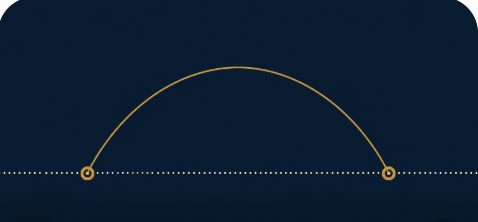
The account never left. A real gain went up, held there a while, and came all the way back down to the exact line it started from.
The Concept
A profit target exists to lock in a decision made with a clear head, before the trade was open and emotion got involved. Once the position is green, every additional tick becomes a new reference point, and giving any of it back starts to feel like a fresh loss, even though the account is still net positive on the trade.
That's why a winning trade with no fixed exit so often turns into a full round trip: entry, gain, give-back, and sometimes a loss, on a trade that was ahead the entire way.
Where It Comes From
The reference-point problem traces back to Daniel Kahneman and Amos Tversky's 1979 prospect theory. Where you currently stand becomes the baseline your brain measures every next dollar against, and that baseline moves as the position moves.
Terrance Odean's 1998 Journal of Finance study found that investors realize their winning positions at roughly one and a half times the rate they realize their losing ones, direct evidence of the same instinct that lets a winner run past its target instead of getting sold at it.
Winners Sold vs. Losers Sold
Odean's 1998 Journal of Finance finding: investors close out winning positions at roughly 1.5 times the rate they close out losing ones. The same instinct that sells a winner early, the disposition effect, is what lets a winner with no fixed target run right past the point where it should have been sold.
Try It: Give Back Your Own Open Gain
Illustrative, not derived from Odean's 1.5x realization-rate finding, it just shows the mechanics that finding explains. Drag past 100% given back and the trade crosses from win to loss without a single new fact about the position, the same round trip the report's own case studies walk through.
Background only. The report itself works an exact gambler's-ruin probability and a 20,000-trade simulation of what letting winners ride actually costs.
Common Questions
Why does a winning trade become a "new" reference point once it's open?
Daniel Kahneman and Amos Tversky's 1979 prospect theory found that where you currently stand becomes the baseline your brain measures every next dollar against, and that baseline moves as the position moves. Once a trade is green, giving any of it back starts to feel like a fresh loss, even though the account is still net positive.
Is there actual evidence traders sell winners differently than losers?
Terrance Odean's 1998 Journal of Finance study found investors realize their winning positions at roughly one and a half times the rate they realize their losing ones, direct evidence of the same instinct that also lets a winner with no fixed target run right past the point where it should have been sold.
What turns a winning trade into a full round trip?
No fixed exit. Entry, gain, give-back, and sometimes a loss, on a trade that was ahead the entire way, because every additional tick of profit becomes a new reference point instead of a locked-in decision made before emotion got involved.
Sources & Further Reading
-
Kahneman, D. & Tversky, A. (1979). “Prospect Theory: An Analysis of Decision under Risk.” Econometrica, 47(2), 263-291.
The reference-point idea behind why an open gain starts to feel like it already belongs to you traces back to this paper.
-
Odean, T. (1998). “Are Investors Reluctant to Realize Their Losses?” The Journal of Finance, 53(5), 1775-1798.
Found investors realize winning positions at roughly 1.5 times the rate they realize losing ones, the exact ratio plotted in the chart above.