Pull the trade history off a blown account and the strategy usually looks fine.
The setups are reasonable. Entries are close enough. What's wrong is somewhere else entirely: a stop widened twice on the same trade, a loser held six days because closing it would make the loss count, a winner sold at 12% of its target out of pure relief, a revenge trade sized twice as large as anything the plan allows, fired off nine minutes after the loss that caused it.
None of that shows up on a backtest. It only shows up in the account, at 2:47 in the afternoon, when the plan and the person holding it stop agreeing with each other.
This course is the six behaviors that do the actual damage: revenge trading, overtrading, FOMO, cutting winners short, moving stops, and breaking your own rules, plus the tilt window that triggers most of them. Documented research behind the mechanism, a calculator that prices out what each one costs in your own numbers, and a 6-week reset most traders build alone, the hard way, or never build at all.
Ten modules. No hype, no willpower speech. You get six patterns priced out in dollars, and a way to catch yourself doing them.
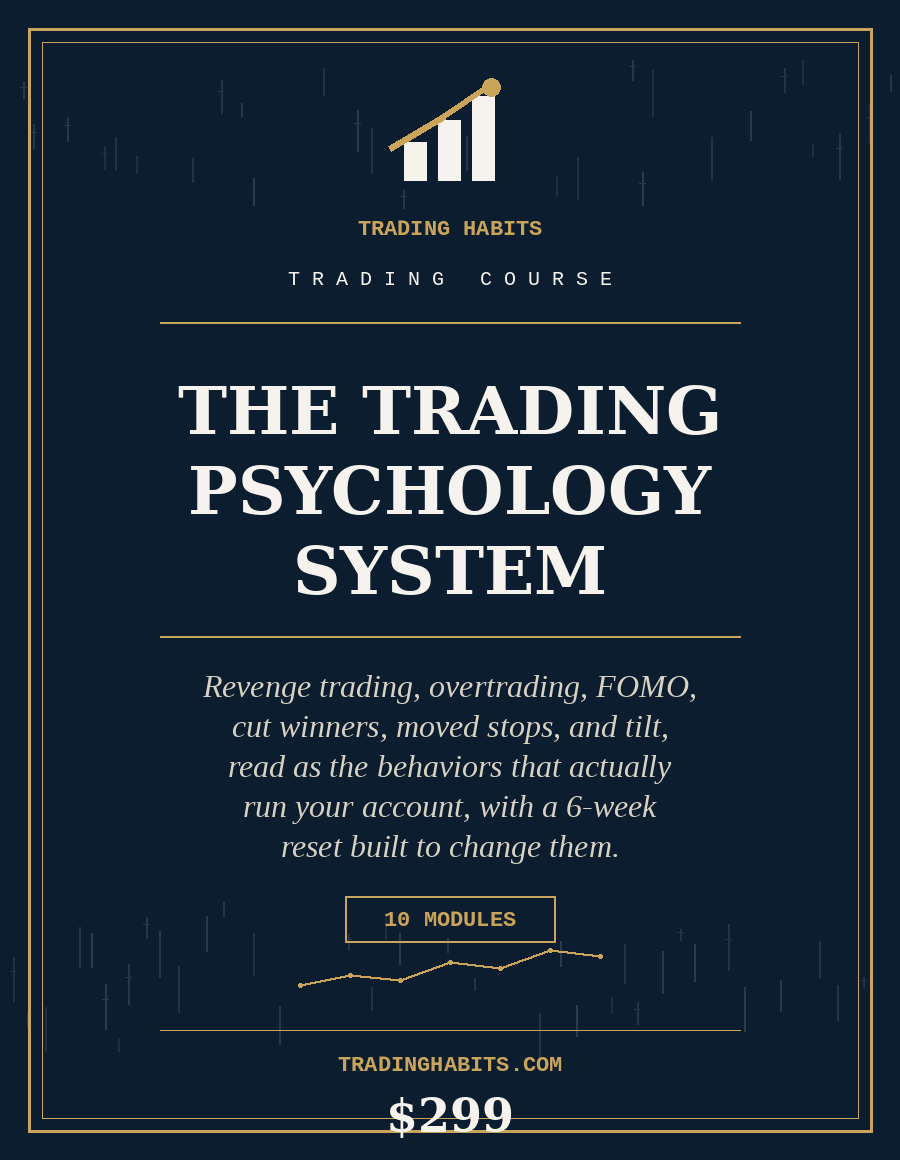
A Trading Habits Course
The Trading Psychology System
Revenge trading, overtrading, FOMO, cutting winners short, moving stops, and breaking your own rules, each one priced out in dollars and traced back to the same short window after a loss.
- Length 10 modules, built for genuine depth, not padding
- Format A private, self-paced course page with a working cost calculator for each behavior, a tilt-score self-assessment, and a rule-builder walkthrough built into the lessons instead of linked out from them
- Access Instant, right after checkout, yours to re-read for good
- Covers Loss aversion and why losses hit roughly twice as hard as equivalent gains, revenge trading, overtrading, FOMO, the disposition effect, stop-widening, rule-breaking under pressure, the post-loss tilt window, a durable rules system, and a 6-week behavioral reset
- Author TradingHabits.com
Built for one job: catching the six behaviors that cost more than any strategy ever could, in the ten or fifteen minutes where they happen.



What's Inside
The 10 Modules
- 01Why the account runs on psychology, not strategy: loss aversion, the value function, and the six behaviors this course is built around.Module 1
- 02Revenge trading: the anatomy of "I'll get it back right now," and a calculator that prices out exactly what it costs.Module 2
- 03Overtrading: the research on why more trades stopped meaning more money, and what the extra trades cost per month.Module 3
- 04FOMO: the chase that's already too late before it starts, and a quiz that separates it from a legitimate breakout entry.Module 4
- 05The disposition effect: cutting winners short and holding losers long, and what that split costs over a full month of trades.Module 5
- 06Moving your stop: the one-inch rule break that isn't, and a calculator for what every widened stop exposes.Module 6
- 07Breaking your own rules: why the ones written calm are the ones broken under pressure.Module 7
- 08Tilt: the window right after a loss that costs more than the loss did, with a scored self-assessment.Module 8
- 09Building a rules system that survives contact with a live account, not a calm Sunday afternoon.Module 9
- 10A 6-week behavioral reset, tracked right in the browser, plus a full self-check across all six patterns.Module 10
Read This Before You Buy
Who This Course Fits
You're a fit if
- Your trade log and your P&L tell two different stories, and you already suspect the difference isn't the strategy.
- You've moved a stop, revenge traded, or held a loser past the point you knew better, more than once.
- You want the actual research behind why these patterns happen, not a motivational push to "trade with discipline."
- You'll use a specific number, not a feeling, to decide whether a habit is costing you money.
- You're willing to run a 6-week reset instead of deciding to be better tomorrow.
Skip it for now if
- You're looking for a new entry strategy or indicator. This course doesn't touch either one.
- You've never placed a live trade. Most of this course assumes a funded account and a loss you've already taken.
- You want a guarantee that reading ten modules fixes a behavior pattern by itself. It won't, and Module 9 explains exactly why the reset has to be structural, not information alone.
- You already track every rule break, size every trade off a formula, and know your own tilt signs cold. You may already have what this course teaches.
HABITS
★
Certificate of Guarantee
60-Day, No-Questions-Asked
If The Trading Psychology System doesn't earn its place in your process, email us any time within 60 days of purchase for a full refund. No form to fill out. No reason required.
Instant Access
$299One-time payment. No subscription.
Get Instant Access10-MODULE DIGITAL COURSE · DELIVERED IMMEDIATELY AFTER CHECKOUT · 60-DAY GUARANTEE
Behind The Course
Where the Loss Aversion and Disposition Effect Research Came From
1979
Psychologists Daniel Kahneman and Amos Tversky published Prospect Theory: An Analysis of Decision under Risk in the journal Econometrica. It replaced the old assumption that people weigh gains and losses evenly with a measured one: losses register as roughly two to two and a half times more painful than an equivalent gain feels good. Kahneman later received the 2002 Nobel Memorial Prize in Economic Sciences for this work, Tversky having passed away in 1996.
1998
Finance professor Terrance Odean published Are Investors Reluctant to Realize Their Losses? in The Journal of Finance, built on actual trading records from roughly 10,000 brokerage accounts. He found investors sold winning positions faster than losing ones, well beyond what tax planning could explain. He named it the disposition effect. Module 5 of this course is built directly on that finding.
Nineteen Years Between the Theory and the Trading-Account Data
Nineteen years separate the theory of why losses hurt more than gains feel good from the study that measured that exact bias inside live trading accounts.
Try It: How Big a Win Offsets a Loss, By Feel
Runs on the same "roughly two to two and a half times" loss-aversion range Kahneman and Tversky's Prospect Theory established in 1979 (Module 1). A loss at the multiplier you set needs a win that much bigger just to feel emotionally even, not only financially even.
Background only. The course itself works the cost math, the tilt window, and the rule-building mechanics a live account runs on.
Common Questions
Why did it take nineteen years between the theory and the trading-specific study?
Kahneman and Tversky's 1979 prospect theory was general decision-making research, not built for markets specifically. Terrance Odean's 1998 study is what applied it directly to roughly 10,000 real brokerage accounts and found the disposition effect inside actual trading behavior, not a lab experiment.
What's the real-world multiplier from the "losses hurt more than gains feel good" finding?
Roughly two to two and a half times, per the original prospect theory research. Use the live tool above to see what dollar gain would need to happen to feel equally good against your own loss amount.
Did Kahneman win the Nobel alone for this work?
He received the 2002 Nobel Memorial Prize in Economic Sciences. Amos Tversky, his research partner, had died in 1996, and the prize isn't awarded posthumously, so only Kahneman's name is on the medal even though the work was a genuine partnership.
Is the disposition effect something you can fully train yourself out of?
The course treats it as manageable, not eliminated. Module 5 is built directly on Odean's finding, and the aim is catching the pattern in your own trades before it costs money, not pretending the underlying instinct disappears.
Sources & Further Reading
-
Kahneman, D. & Tversky, A. (1979). “Prospect Theory: An Analysis of Decision under Risk.” Econometrica, 47(2), 263-291.
The loss-aversion finding this course opens with: losses register as roughly two to two and a half times more painful than an equivalent gain feels good. Module 1 and the calculator above are both built on this ratio.
-
Odean, T. (1998). “Are Investors Reluctant to Realize Their Losses?” The Journal of Finance, 53(5), 1775-1798.
Built on roughly 10,000 real brokerage accounts. The direct source of Module 5's disposition-effect lesson.