There's a 3-second decision that shows up in more damaged trading accounts than any single strategy, indicator, or news event.
It's not overtrading.
It's not revenge trading, at least not directly.
It's not even leverage, although leverage makes it worse.
It's not a bad entry, a bad setup, or a bad indicator.
It happens after the trade is already open, already losing, and already sitting exactly where you planned to exit.
Researchers who study this have a name for it: the disposition effect.
It's a term from academic finance, not from a trading Discord.
It's been documented in the trading of professional futures traders and mutual fund managers. Not just beginners.
It isn't about greed. It isn't about fear either.
It's about which version of a loss your brain is willing to look at.
Somewhere between the stop you planned at 9:31 a.m. and the one you moved at 9:47, the trade stopped being about the market.
One walked-through example turns a $100 planned loss into $560, without a single new fact about the trade itself.
Another turns a leveraged position's $180 stop into a loss nearly 9 times that size.
Neither one required a worse strategy.
Both required one decision, made under pressure, that a calmer version of the same trader would never have made.
That 3-second decision has a name, a body of research behind it, and a documented multiple on what it tends to cost.
All three are laid out below, with the exact page where each one is discussed.
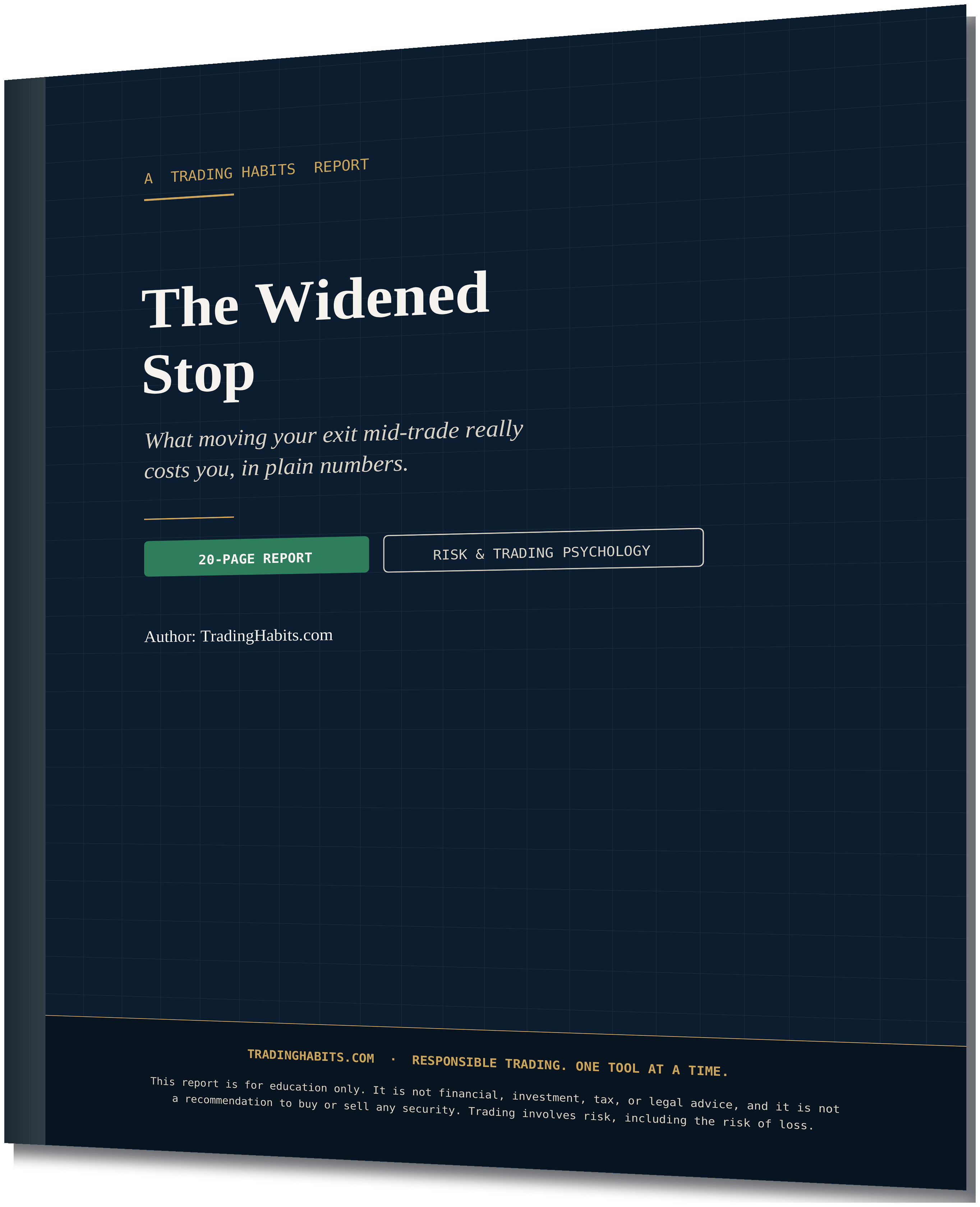
A Trading Habits Report
The Widened Stop
What moving your exit mid-trade really costs you, in plain numbers.
- Length 20 pages, with 8 original charts and data tables
- Author TradingHabits.com
- Format PDF, delivered as an instant download right after checkout
- Covers The psychology behind widening a stop-loss, what it costs in worked-through numbers, and what the research says reduces it
This report breaks down the research, the math, and a plan you can use on your next trade.
What's Inside
20 Things This Report Actually Says
- 01The exact multiple a loss can grow to after just one widened stop, worked through step by step with real numbers.Page 7
- 02The specific reason a widened stop moves faster toward real damage on a leveraged position than on a plain stock trade.Page 8
- 03The one number researchers use to explain why losing $100 hurts roughly twice as much as gaining $100 feels good.Page 4
- 04What a study of 10,000 real brokerage accounts found about how much more likely traders are to sell their winners than their losers.Page 5
- 05What a widened stop is actually protecting. It is not the account.Page 6
- 06This is not a beginner's mistake. The same bias has been documented in the trading of professional futures traders and mutual fund managers.Page 5
- 07Why the size of a loss tends to grow faster with each additional widen, not slower.Page 9
- 08The cited share of prop firm evaluations lost to a risk-rule breach, not a bad trade idea.Page 10
- 09The percentage of retail traders who stay net profitable past three years, according to three separate regulator and academic studies.Page 11
- 10Five things traders tell themselves right before widening a stop, and which bias sits behind each one.Page 12
- 11Two simulated trading sequences. Same entries. Same win rate. One ends profitable. One does not. The only difference is on this page.Page 13
- 12One number that changes when roughly one in three losing trades gets its stop widened, and what it does once it compounds across a year of trades.Page 14
- 13The one difference a UK stop-loss study found between traders who fall for this bias and traders who mostly don't.Page 15
- 14Four order types already sitting on most broker platforms that remove the decision to widen a stop before it can happen.Page 16
- 15A written stop-loss plan built from four short lines, filled out before the pressure to break it exists.Page 17
- 16Four questions worth asking after any trade where the stop got moved, and exactly what each one is checking for.Page 18
- 17Three specific ways a stop gets widened. One of them does not involve touching an order at all.Page 3
- 18A widened stop feels like patience. The research says it is something else entirely.Page 6
- 19Every number cited in this report, gathered on one page with the page it came from.Page 19
- 20The one page in this report worth going back to more than any other, and what it costs to act on it.Page 20
HABITS
★
Certificate of Guarantee
60-Day, No-Questions-Asked
If The Widened Stop doesn't earn its place on your desk, email us any time within 60 days of purchase for a full refund. No form to fill out. No reason required.
Instant Download
$7One-time payment. No subscription.
Order Now20-PAGE PDF · DELIVERED IMMEDIATELY AFTER CHECKOUT · 60-DAY GUARANTEE
Behind The Report
Loss Aversion And The Disposition Effect
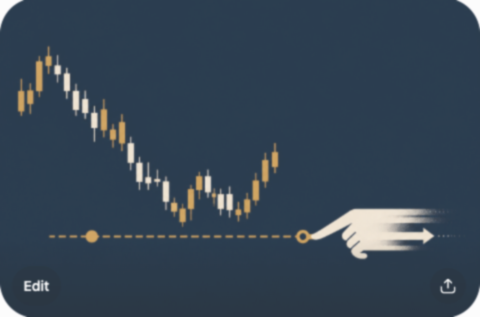
The 3-second decision this report is built around: a planned exit gets nudged further away right as the trade turns against it.
The Concept
Loss aversion is the finding that a loss and an equal-sized gain don't register the same in your head. Losing $100 hurts more than gaining $100 feels good, by something close to a factor of two in most studies. Once a stop-loss represents the moment a loss becomes real, moving it stops being a chart decision. It's an attempt to postpone a feeling.
The disposition effect is that same instinct showing up in an account: the well-documented pull toward selling winners early and holding losers long, wide stop included. Same reflex, wearing a technical-analysis excuse.
Where It Comes From
Daniel Kahneman and Amos Tversky named loss aversion inside a broader theory they called prospect theory, published in Econometrica in 1979. Kahneman won the 2002 Nobel Prize in Economics for the work. Tversky had died six years earlier, and Nobel prizes aren't awarded posthumously, so his name is on the paper but not on the medal.
Hersh Shefrin and Meir Statman gave the trading-specific version its name in a 1985 Journal of Finance paper: the disposition effect. Widening a stop is one of the clearest ways it shows up in a live account.
How Far A Widened Stop Can Drift The Loss
The report's own worked example: a $100 planned loss widens step by step to $560, and a leveraged position's $180 stop drifts to nearly nine times that size. Same stop-widening decision, made repeatedly, not a worse trade idea.
Try It: Drag Your Own Loss Through The Same Widens
Same four multipliers as the chart above (1.0x, 2.0x, 3.6x, 5.6x), applied to whatever number you'd actually be planning to lose. Move the slider and watch the amount most traders never recalculate out loud.
Background only. The report itself walks the actual math of what a widened stop costs across a real account, trade by trade.
Common Questions
Is loss aversion the same thing as the disposition effect?
Related, not identical. Loss aversion is the psychological finding from Kahneman and Tversky's 1979 prospect theory: a loss hurts roughly twice as much as an equal gain feels good. The disposition effect, named by Shefrin and Statman in 1985, is that same instinct showing up in trading behavior specifically, selling winners early and holding losers long. Widening a stop is the disposition effect wearing a chart-analysis disguise.
Does this bias go away with experience?
The report cites documentation of the same pattern in professional futures traders and mutual fund managers, not just beginners. Experience changes a lot of things. This isn't reliably one of them.
What actually stops a stop from getting widened?
Removing the decision, mostly. The report walks through four order types already sitting on most broker platforms built for exactly that, plus a four-line written plan filled out before the pressure to break it shows up.
Does the multiplier in the chart above apply to every trade?
No, it's the report's own worked example: a $100 planned loss compounding through three widens to $560. Your own numbers will differ, which is exactly why the live tool above lets you run your own loss amount instead of the example.
Sources & Further Reading
-
Kahneman, D. & Tversky, A. (1979). “Prospect Theory: An Analysis of Decision under Risk.” Econometrica, 47(2), 263-291.
Named loss aversion inside this paper. It is the reason a widened stop still feels like the safer choice in the moment it gets moved.
-
Shefrin, H. & Statman, M. (1985). “The Disposition to Sell Winners Too Early and Ride Losers Too Long: Theory and Evidence.” The Journal of Finance, 40(3), 777-790.
Gave the trading-specific version of loss aversion its name, the disposition effect, which is what a widened stop looks like inside a live account.